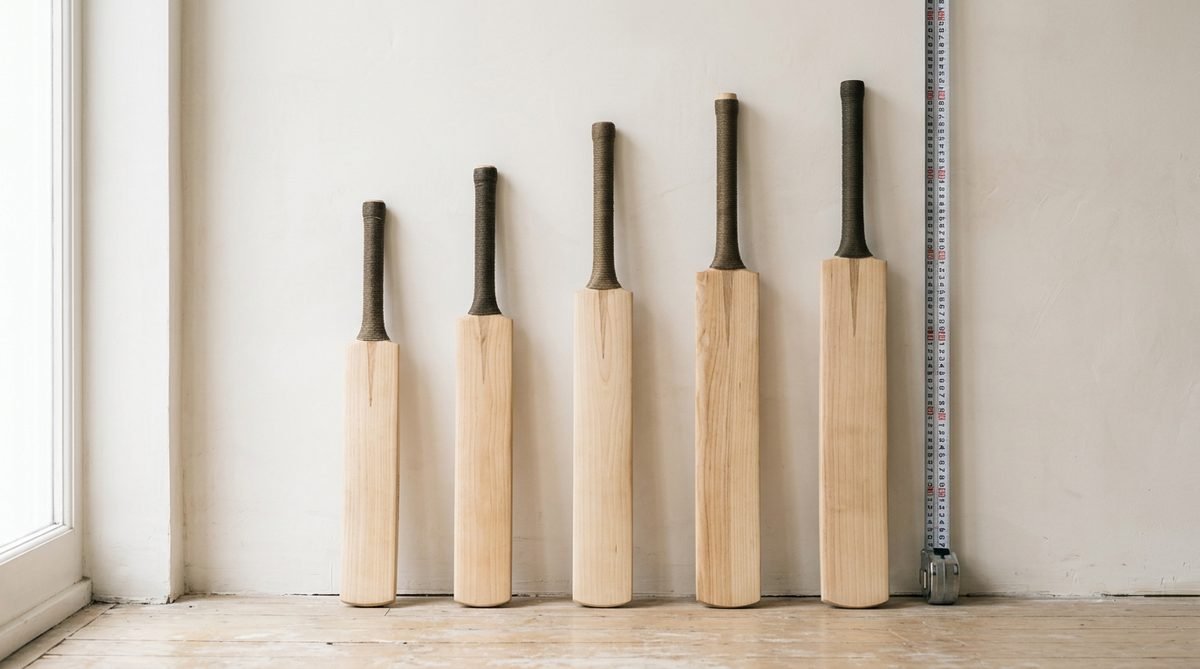
Choose a cricket bat by the player’s height, not their age. As a rough guide, children under 4 ft (122 cm) use a Size 0 and step up roughly every 7–8 cm of height through Sizes 1 to 6. Teenagers around 5 ft 5 in–5 ft 7 in (165–170 cm) use a Harrow, and most adults from about 5 ft 9 in (175 cm) use a Short Handle (SH), with Long Handle or Long Blade bats for players over 6 ft.
The table below combines the published size guides of Gray-Nicolls and Kookaburra, two of the biggest bat makers. Use it with the simple fit tests further down, because two children of the same height can still need different bats.
We may earn a commission from Amazon links, at no extra cost to you. See our disclosure.
Cricket bat size chart
| Bat size | Player height (ft/in) | Player height (cm, approx) | Approx age | Approx bat length |
|---|---|---|---|---|
| Size 0 | Under 4’0″ | Under 122 | 4–5 yrs | 61 cm (24″) |
| Size 1 | 4’0″–4’3″ | 122–130 | 6–7 yrs | 65 cm (25.5″) |
| Size 2 | 4’3″–4’6″ | 130–137 | 7–9 yrs | 69 cm (27″) |
| Size 3 | 4’6″–4’9″ | 137–145 | 9–11 yrs | 72 cm (28.5″) |
| Size 4 | 4’9″–5’0″ | 145–152 | 10–12 yrs | 75 cm (29.5″) |
| Size 5 | 5’0″–5’3″ | 152–160 | 11–13 yrs | 78 cm (30.5″) |
| Size 6 | 5’3″–5’5″ | 160–165 | 13–15 yrs | 79 cm (31.25″) |
| Harrow (H) | 5’5″–5’7″ | 165–170 | 15+ yrs | 81 cm (32″) |
| Small Adult / Super Lite | 5’7″–5’9″ | 170–175 | 16+ yrs | 83 cm (32.75″) |
| Short Handle (SH) | 5’9″ and over | 175 and over | 16+ / adults | about 84–86 cm (33–34″) |
| Long Handle (LH) / Long Blade (LB) | 6’0″ and over | 183 and over | Tall adults | about 87–88 cm (34.5″) |
Sources: heights and ages from Gray-Nicolls UK’s size guide; centimetre ranges from Kookaburra’s size guide; bat lengths rounded from the overall lengths Kookaburra Australia publishes. Lengths vary slightly between brands and models, and Indian makers often list their adult SH bats as suitable from about 5 ft 6 in (168–171 cm).
How to read the chart
Height beats age
The age column is only a rough guide. A tall 10-year-old may need a Size 5, and a small 13-year-old may still be on a Size 4. Gray-Nicolls and Kookaburra both base their charts on height alone. Measure your child barefoot against a wall, then use the height columns.
Brands don’t agree exactly
The charts overlap but are not identical. Kookaburra Australia, for example, lists Short Handle for players 6 ft and over, with a 5 ft 9 in–6 ft “Short Blade” in between. Gray-Nicolls UK starts SH at 5 ft 9 in, and its FAQ says Harrow typically suits players of about 5 ft 3 in–5 ft 8 in. Indian brands such as SG and SS often label their SH bats as suitable from about 5 ft 6 in. If you are near a boundary, check the chart on the brand’s own listing.
What the adult sizes mean
- Harrow: the size between junior Size 6 and adult bats. Common for 14–16-year-olds and shorter adults.
- Small Adult / Super Lite / Short Blade: in-between sizes some brands make for players around 5 ft 7 in–5 ft 9 in, and popular with women and slighter players.
- Short Handle (SH): the standard adult bat and by far the most common. If an Indian listing just says “full size”, it usually means SH.
- Long Handle (LH): a standard blade with a longer handle, for tall players who want more reach without a longer blade.
- Long Blade (LB): a standard handle with a longer blade, for tall players who stand upright at the crease.
Three quick fit tests
Once you have a size from the chart, check it with these tests. They take a minute in a shop or at home when the bat arrives.
- The wrist test: stand upright with the bat’s toe on the ground beside your back foot. The top of the handle should reach roughly the crease of your wrist. Up to mid-forearm is acceptable for a growing junior. Any higher and the bat is too big.
- The stance test: take your normal batting stance. The bat should rest by your back toe without you bending over or locking your arms straight.
- The back-lift test: Gray-Nicolls recommends that players can lift the bat into their normal back-lift comfortably. If the child’s elbow drops or the bat wobbles at the top, it is too big or too heavy.
Why the right size matters
An oversized bat is the most common mistake parents make, usually with good intentions (“he’ll grow into it”). A bat that is too long or too heavy forces the batter to choke down on the handle, drag the bat across the line and swing late. Those habits take years to coach out. Too heavy a bat can also strain young wrists and forearms.
A bat that is a little too small is far less harmful. It costs some reach, but it keeps technique straight. If a child sits between two sizes, choose the smaller one unless they are strong for their age and the larger bat passes the back-lift test.
Weight matters as much as size
Two bats of the same size can feel very different. Kashmir willow is denser than English willow, so a Kashmir bat of the same shape usually weighs more. That is one reason a lighter-pickup bat suits juniors. Read our Kashmir vs English willow guide for the full comparison. For children, choose the lightest well-made bat in the right size; for adults, most leather-ball SH bats on Amazon.in list weights of about 1,150–1,250 g.
Example junior bats by size
Most Indian brands sell their popular models across junior sizes, so you can stay with a model you trust as the child grows. Two widely listed examples on Amazon.in, chosen based on specs and verified buyer feedback (not our own testing): the SG Scorer Classic Kashmir willow bat, sold in sizes from about 3 to 6 and SH, at roughly ₹1,800–2,900 depending on size (Nov 2026), and the SG Sierra 100 English willow bat, sold in sizes 3 to 6 and SH, at roughly ₹6,900–8,700, for juniors who already play regular leather-ball cricket. Always pick the size variant on the listing, and check its height chart.
Buying a full set for a young cricketer? Our best cricket kits for kids lists kits matched by bat size. For budget picks, see the best cricket bats under ₹2,000.
How to choose the right size
- Measure height first, barefoot, in centimetres or feet and inches.
- Find the row in the chart and note the size. If the player is right on a boundary, look at the brand’s own chart.
- Check the weight on the listing. For juniors, lighter is usually better within the right size.
- Do the wrist, stance and back-lift tests when the bat arrives. Return it if it fails them.
- Don’t buy two sizes up. Children typically need a new bat every one or two seasons. That is normal, and a big reason to choose Kashmir willow for younger players.
- Use the right ball. Junior bats used with a leather ball still need some knocking in; see how to knock in a cricket bat. For backyard practice with a tennis ball, try our batting drills at home.
FAQ
What size cricket bat for a 10-year-old?
Usually a Size 3 or Size 4, but go by height. A child of 137–145 cm (4 ft 6 in–4 ft 9 in) fits a Size 3, and one of 145–152 cm (4 ft 9 in–5 ft) fits a Size 4.
What size bat does a 5 ft 6 in adult need?
A 5 ft 6 in player sits between Harrow and Small Adult on the Gray-Nicolls and Kookaburra charts. Many Indian brands sell SH bats as suitable from about 5 ft 6 in. If an SH bat passes the wrist and back-lift tests, it’s fine; if it feels long, choose a Harrow or a Small Adult/Super Lite model.
Is Harrow the same as Size 7?
Effectively, yes. Harrow is the size after Size 6 and before the adult sizes. Some shops call it “Size 7”, but most brands use Harrow or “H”.
What’s the maximum size of a cricket bat?
Under the Laws of Cricket, a bat can be no longer than 38 in (96.5 cm) overall and no wider than 4.25 in (10.8 cm). Even Long Blade and Long Handle adult bats sit well inside these limits.
Can my child use an adult bat with the handle cut down?
It is not a good idea. Shortening the handle doesn’t fix the blade’s length or weight, so the bat stays heavy and badly balanced for a child. Buy the correct junior size instead.