If you play leather-ball cricket regularly for a school, club or academy side, and your budget can stretch to roughly ₹6,000 or more, buy an English willow bat: it is lighter for its size and the ball comes off the middle faster. If you are a beginner, a growing junior, mostly play tennis-ball or tape-ball cricket, or have under ₹3,000 to spend, a good Kashmir willow bat is the smarter buy. It is tougher on rough practice pitches and needs far less preparation.
The rest of this guide explains why, what you really get for the extra money, and a few example bats at each level so you know what a sensible shortlist looks like.
We may earn a commission from Amazon links, at no extra cost to you. See our disclosure.
Kashmir vs English willow at a glance
| Kashmir willow | English willow | |
|---|---|---|
| Where it grows | Kashmir valley, India | Plantations in England (mainly the east and south-east) |
| Wood | Harder, denser, usually darker | Softer, lighter, more fibrous, usually paler |
| Grains | Fewer, wider, less regular | More visible, straighter grains on better grades |
| Feel off the bat | Less rebound; you have to time and push the ball more | More “ping”; the ball travels further for the same swing |
| Weight for the same shape | Heavier | Lighter, so makers can give bigger edges at the same weight |
| Preparation | Little or none; many come ready to play | Oiling and several hours of knocking in, unless pre-knocked |
| Typical Amazon.in price (adult SH, Nov 2026) | About ₹1,500–4,500 | Entry grades from about ₹5,000; club and match grades ₹8,000–30,000+ |
| Best for | Beginners, juniors, gully and tennis/tape-ball cricket, net practice | Regular leather-ball matches, school and club teams, serious juniors |
Are they really different trees?
Not really. Good bat willow in England is Salix alba var. caerulea, the “cricket bat willow”. The bat units in the Kashmir valley largely use the same variety. Researchers at SKUAST-Kashmir have even argued that Kashmir-grown caerulea compares well with English timber on paper. The difference comes from climate, soil, water and how the wood is grown, seasoned and graded.
English willow grows on wet lowland plantations and is carefully pruned and graded by an organised industry. Kashmir willow grows in a drier climate and comes out harder and heavier. It is also graded less consistently. In practice, the same bat shape made from Kashmir willow weighs more and returns less energy to the ball. That is the gap you feel in your hands.
Performance: what the extra money buys
Ping and sweet spot
English willow compresses and springs back when the ball hits it, and that is where the ping comes from. A well-pressed English willow bat rewards a decent swing with distance, and slight mis-hits still travel. Kashmir willow is stiffer and absorbs more of the impact. Middled shots still go, but you need more bat speed and better timing, and off-centre hits sting the hands more.
Weight and pick-up
Because English willow is lighter for its volume, makers can shape a big-edged, thick-spined bat that still picks up well. A Kashmir bat with the same profile would be too heavy, so Kashmir bats either have smaller edges or weigh more. Many adult Kashmir bats on Amazon.in list weights around 1,170–1,250 g. Check the listing, because pick-up (how the weight is balanced) matters as much as the number on the scale.
Durability
This one surprises people. Kashmir willow is harder, so it dents less in its first weeks and copes with mishandling: cold mornings, damp grass, cheap practice balls, hitting a wall in the gully. English willow is softer and must be knocked in before it faces a new leather ball, or the face and toe can crack. Looked after properly, a good English willow bat gives several seasons of play. Neglected, it can be ruined quickly. Kashmir willow forgives neglect. English willow rewards care.
Which willow for which cricket?
- Tennis-ball and tape-ball cricket: Kashmir willow, or a dedicated tennis bat. Do not waste English willow on a tennis ball; you won’t feel the benefit. See our tennis-ball bat picks.
- First leather-ball season, age 8–14: Kashmir willow in the correct size. Children grow out of bats fast, and a cheaper bat means you can size up without regret. Check the cricket bat size chart first.
- Net practice only, or a second “rough” bat: Kashmir willow. Save the good bat for matches.
- Regular school, academy or club matches with a leather ball: English willow. Even an entry grade gives you better pick-up and more ping than the best Kashmir bat.
- Serious junior moving to Harrow or Short Handle: English willow if they train at least twice a week and will look after it.
Example bats at each level
These are not ranked recommendations from testing; we have not played with them. They are well-known models listed on Amazon.in or the maker’s own store, chosen as examples based on specs and verified buyer feedback. Prices are approximate for November 2026 and change often.
1. SS Master 100 (Kashmir willow, Short Handle)
An entry-level leather-ball Kashmir bat from Sareen Sports (SS). The Amazon.in listing gives a weight of about 1,200 g and says it does not need knocking. Expect about ₹1,900–2,800 on Amazon.in. A sensible first adult bat for gully, nets and casual matches. Check price on Amazon.in
2. SG Sierra Plus (Kashmir willow, Short Handle)
SG’s popular Kashmir model, listed at roughly 1,170–1,220 g, with a Singapore cane handle and a medium sweet spot. The listing says it needs knocking, so give it a light knock before using a hard ball. About ₹2,300–2,700 on Amazon.in. Check price on Amazon.in
3. SS TON Maximus (Kashmir willow)
A higher-grade Kashmir bat (SS lists it as Grade 3 Kashmir willow, air-dried, with concave edges) for players who want a sturdier, better-shaped Kashmir option before stepping up. SS’s own store lists it at about ₹4,100; Amazon.in prices vary by size. Search on Amazon.in
4. SG Sierra 100 (English willow, Short Handle and junior sizes)
One of the more affordable English willow bats from a big Indian maker, sold in Short Handle and junior sizes 3–6. It’s a realistic first English willow bat for a club or school player. About ₹6,900–8,700 on Amazon.in and SG’s store. Knock it in properly before match use. Check price on Amazon.in
If your budget sits between these two levels, see our round-ups of the best cricket bats under ₹2,000 and the best cricket bats under ₹5,000.
Watch out for “English willow” at Kashmir prices
Amazon.in has plenty of bats labelled “Grade 1 English willow” for ₹2,000–4,000, often from unfamiliar brands with a huge “M.R.P.” and a 60–70% discount. Some are genuine low-grade English willow, but the price is a warning sign. A few simple checks help:
- Brand and seller: buy from the brand’s own store page or a well-reviewed seller. Read recent reviews that mention cracks or weight.
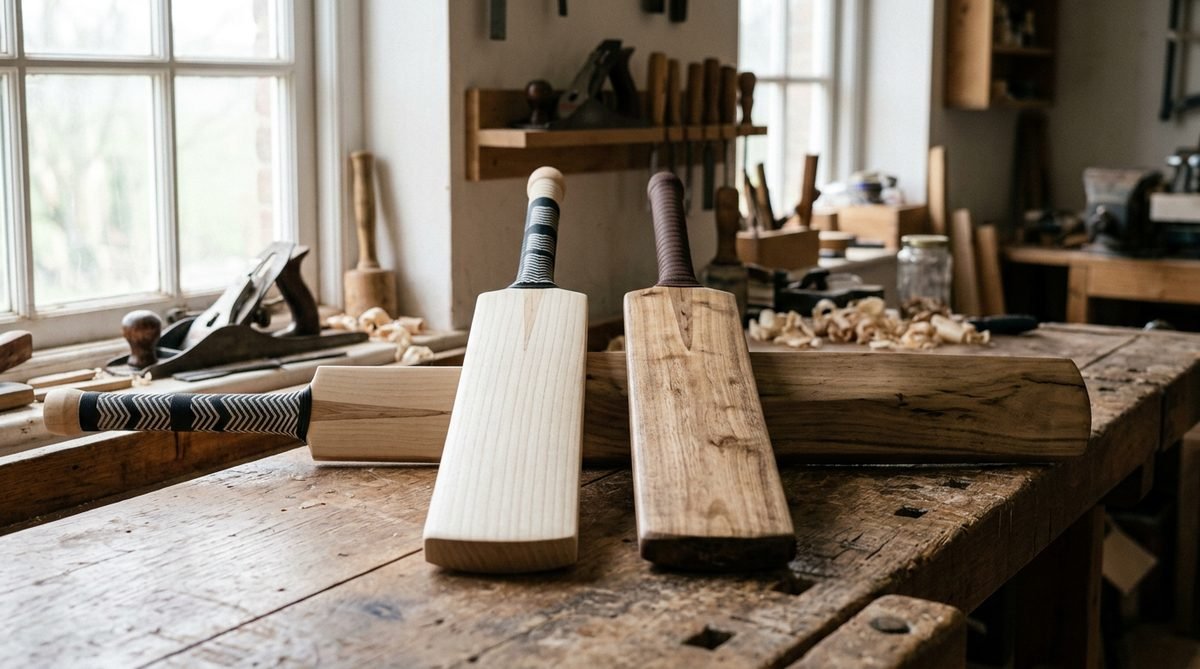
- Colour and grain: English willow is usually pale, with clear, fairly straight grains running down the face. Kashmir willow is darker, with fewer and wider grains.
- Weight claims: an adult SH bat with big edges claiming under 1,100 g at a Kashmir price deserves suspicion.
- Grade: grading is not standardised across brands. “Grade 1” from a brand you’ve never heard of is not the same as a top-brand Grade 1.
How to choose
- Start with the ball you play with. Tennis or tape ball: Kashmir or a tennis bat. Leather ball every weekend: English willow if you can afford it.
- Get the size right before the willow. A correctly sized Kashmir bat beats an oversized English willow bat every time, especially for children.
- Set a budget. Under ₹3,000 means Kashmir willow. ₹5,000–10,000 buys entry-level English willow from a known brand. Above that, you are paying for higher grades, better grains and pre-knocked finishes.
- Pick up the bat if you can. Balance matters more than the weight on the label. If buying online, choose a listing with clear return terms.
- Budget for care. English willow needs linseed oil, a mallet and a few hours of knocking in. Our guide on how to knock in a cricket bat walks you through it.
- Protect your hands too. A better bat is no use if your gloves are worn out. See our batting gloves guide.
FAQ
Is Kashmir willow allowed in leather-ball matches?
Yes. The Laws require the blade to be made of wood and set size limits, but they do not say where the willow must come from. Plenty of school and club cricketers in India play leather-ball matches with Kashmir willow bats.
Does a Kashmir willow bat need knocking in?
Many are sold ready to play, often with a protective face cover. If the listing says it needs knocking, give it a short knock-in session and some gentle throw-downs with an old leather ball before a match. That is far less work than an English willow bat.
How long does an English willow bat last?
It depends on how often you play and how well you look after it. With proper knocking in, light oiling and dry storage, a good English willow bat usually lasts several seasons of club cricket. Skipping the knock-in or leaving it in a damp kit bag shortens that sharply.
Should I buy my child an English willow bat?
Usually not for the first few seasons. Children change sizes every year or two, and a correctly sized Kashmir bat is cheaper to replace. Move to English willow when they play regular leather-ball matches and are close to Harrow or Short Handle size. If you’re buying everything at once, see our best cricket kits for kids.
Is a ₹3,000 “English willow” bat better than a good Kashmir bat?
Not always. A very cheap English willow bat is often a low grade with poor grains and can crack easily. A well-made Kashmir bat from a known brand may serve a beginner better. Buy on brand, reviews and fit, not the label alone.